Showing posts with label History. Show all posts

Thursday, August 20, 2015

Rubber Limbs and the USS Oneida

Running a blog that thrives on old periodicals means constantly pouring through moldering magazines and newspapers in search of the odd and intriguing. In the six or so years I've been publishing my missives on the past I've seen hundreds of ads for cars, trains, ships, planes, canned goods, candy, and vacations around the world, but this week I stumbled across a first: an ad touting artificial limbs. 

A. A. Marks wasn't the first company to manufacture artificial limbs. The earliest example comes from Capua, Italy where a bronze, iron, and wood leg dating back to 300 BC was unearthed during an 1858 excavation. Through history the art of replacing lost limbs ebbed and advanced, often in step with the history of human conflict. In the early 14th century a German mercenary invented the first hand with movable joints. Through the 17th and 19th centuries advances in articulation continued and with the scourge of amputations that attended the American Civil War, companies like A. A. Marks continued to push the prosthetic envelope.


The ad comes from the April 1893 edition of Railway Carmen's Journal and features a stalwart looking gentleman in US Navy uniform wearing a cap that bears the name of the U.S.S Oneida. The Oneida met its fate twenty-three years prior to the running of Marks' ad and she saw action in the Civil War, either of which would explain the gentleman's advanced age. It's hard to be certain, but a further look through the magazine revealed I'd apparently just been ignorant of just how many ads for prosthetic limbs were running at the time. It's hard to know if the reason owes to the dangerous nature of the railroad industry at the turn of the last century or if it's a testament to the number of men who would have been in the market to upgrade the prosthesis they'd been living with since the war.

Sunday, June 29, 2014

And the War Begins


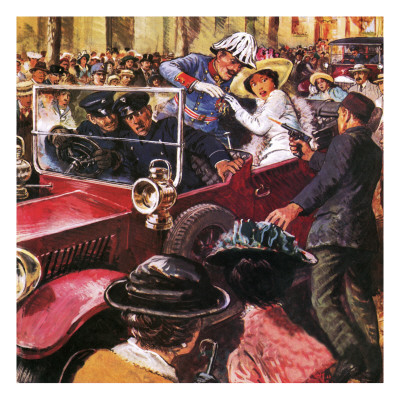
Today was the day it all started. On June 29, 1914 Archduke Ferdinand and his wife Sophie arrived in Sarajevo to dedicate a state museum, unaware that the Black Hand had been at work arranging an attack meant to protest Austro-Hungarian rule over lands the organization believed should be unified as part of a Serb-speaking homeland. That morning the Archduke's party had travelled by train from Ilidza Spa to Sarajevo where the met the governor at the station and proceeded n a motorcade of six Graf and Stift Double Phaeton open convertibles.


The first stop that morning was for an inspection of a military barracks. At ten o'clock the motorcade left the barracks and passed by the first would-be assassin in front of the garden of the Mostar Cafe who failed to detonate the bomb he'd been armed with. At ten after ten the car of the Archduke approached the second assassin who threw his bomb which bounced off the folded top of the convertible and landed in the street where it exploded under the next car and wounding a number of bystanders.

Alerted that all was not well, the motorcade sped away leaving the Archduke's would-be killer to the mercy of the Sarajevo police and a mob of angry citizens. The Archduke and his wife arrived at the Sarajevo town hall where, after protesting "Mr. Mayor, I came here on a visit and I get bombs thrown at me. It is outrageous!", Franz Ferdinand gave a speech while still bloody from the botched bomb attack.

Inexplicably the Archduke and his party continued from the town hall at ten forty five, travelling along Apple Quay toward the Sarajevo hospital where they planned to visit those injured in the bombing. Due to a miscommunication, the driver took a wrong turn and they ended up on Franz Josef Street. When he noticed the error, the governor of Sarajevo who was sharing the royal car ordered the driver to stop and return to Apple Quay. He stopped to turn around near Schiller's Delicatessen near the Latin Bridge, directly in front of where the final assassin was waiting.


The fatal shots were fired from a distance of just over five feet with a Belgian 9x17 model 1910 semi-automatic pistol. The first shot struck the Archduke in the neck and the second struck the Duchess in the abdomen.  Both died while being driven to the Governor's residence for medical treatment. The days and months that followed would see Russia, Germany, France, Belgium, and England enter a conflagration that would become the Great War, World War I.

Wednesday, June 18, 2014

The War of 1812

On this date in 1812 James Madison signed the declaration that started the War of 1812 with Great Britain. War was opposed by a sizable minority, but the British economic blockade of France, the pressing of American sailors into service aboard British vessels, and the British support for hostile Great Lakes tribes on the American frontier gave congressional war hawks the support they needed.

American forces began the conflict by launching a three-point invasion of Canada, which failed miserably. In 1914 Napoleon Bonaparte's empire began to crumble, allowing the British to focus on combat in America. Washington DC fell that year and in August the White House, the Capitol, and other government were burned by British and Canadian troops as repayment for similar acts of arson by US troops while in Canada.

September brought the turning of the leaves and the tide. Thomas Macdonough won the Battle of Plattsburg Bay on Lake Champlain, forcing the invading British to retreat back to Canada and leading to the conclusion of US-British peace negotiations in Belgium. On Christmas Eve 1814 the Treaty of Ghent was signed and the War of 1812 formally came to an end, but it wasn't the end of hostilities.

Communication of the era being what it was, British forces assailing the US Gulf Coast weren't informed of the treaty for weeks. On January 8, US forces under the command of Andrew Jackson achieved what is arguably the greatest American victory of the war when they routed the British at the Battle of New Orleans. News of the Treaty of Ghent and Jackson's victory reached the US public nearly simultaneously, fostering a false connection between the two, encouraging a new found sense of confidence in American power, and providing inspiration for a 1960's hit by Johnny Horton.


Saturday, April 5, 2014

The Marriage of Pocahontas

On the anniversary of the marriage of Pocahontas and John Rolfe, I found myself considering what has become of the woman that we've made into a Native American princess. I think it's safe to say that most anyone who's watched Dances with Wolves or any of the hundreds of Hollywood movies which feature Native American protagonists can see we have a habit of romanticizing and mythologizing the peoples we brutally displaced while carving out our nation. I  tend to think of this as a kind of national survivor's guilt. We're still here and we rewrite our history to create a soft-lit, glowing version of the past. This not only lets us avoid focusing on the horrible, racist truth, but it also flattens the complex nature of Native Americans into a convenient, 2D image of the noble savage that we can carry around with us. The unwieldy truth is that Native Americans like Pocahontas were complex, conflicted characters who were just as often at odds with one another as with the invaders who were striving to take their lands and extinguish their cultures.

Seeking the truth we can easily shed the Disney princess version of Pocahontas. Disney simply manufactured another branded, Technicolor princess who could easily be merchandised to little girls so they'd beg mom and dad to buy the Pocahontas t-shirt, lunch box, and McDonald's kid's meal and thereby fill the corporate coffers. What's known is that Pocahontas was born the daughter of Powhatan, chief of a group of tribes in the Tidewater region of Virginia. Stories out of the Virginia settlements would have us believe Pocahontas saved the captive John Smith in 1607, putting herself in the way of her father's war club to stay Smith's execution. Whether or not this intervention really took place is debatable, what can be said for certain is that in 1613 the English took Pocahontas hostage, holding her for ransom, and during this time she converted to Christianity and took on the Anglicized name of Rebecca.

On April 5th, 1614 Rebecca married tobacco planter John Rolfe, bearing him a son the following January (Thomas Rolfe). In 1616 she traveled to London with her husband, but her adoption of an English name and religion didn't make her English. John paraded his wife in front of English society, presenting her as an example of a "civilized" savage in hopes of encouraging investment in the new Jamestown settlement. Her tour of London could be considered a success, Rebecca Rolfe became a celebrity of sorts, the subject of talk throughout the British capital, and even was invited to attend a masque at Whitehall Palace.

In 1617 John and Rebecca departed for Virginia but they never made it past Gravesend. Rebecca had been ill when she boarded the ship and the unknown illness worsened as they traveled. She supposedly died in John's arms while disembarking and was buried in a church in Gravesend. Today the exact location of her grave is unknown, but this hasn't stopped numerous Americans demanding the return of her remains to Virginia.

According to church records, Rebecca was buried under the floor of the old Gravesend church, however this church burned in 1727 leaving doubt as to the exact location of the body. In 1923 Edward Page Gaston obtained permission from Canon Gedge of St. George's church to dig on the location of the old Gravesend church, but his efforts failed. In more recent times Las Vegas entertainer Wayne Newton got on the Pocahontas repatriation bandwagon, failing just like his predecessors and proving that celebrity doesn't ensure success.

Where do I stand? Well, on the side of history, I like to think. Pocahontas recreated herself as Rebecca Rolfe, a Christian Englishwoman and wife of John Rolfe. She died in Gravesend and was buried there in accordance with the tenants of her adopted religion. There's no more point in repatriating her to the land she so thoroughly left behind than there would be in repatriating the remains of every settler born in England to the land of their birth. In the end, we aren't what we were born into, we are what be grow to become.

For those of us who like to opinionate on "historically significant" figures like Pocahontas I would offer this word of caution. Some day you will be in your grave and everything you wrote, thought, and said will be nothing but dust - when that happens who will decide what's right for you and what right do they have to make those decisions in your irreversible absence?


Tuesday, January 14, 2014

A Window on the Past

Sometimes, while pouring through the archives, I come across an address. It might be part of an ad or a mention in an article, but I'm always left wondering what's at that geographic point today. Most of the time the end result of my search is disappointing., humanity has a bad habit of obliterating its architectural past, but there are occasional surprises.

The photo to the right was snipped from a 1921 issue of American Cookery a now defunct cooking and lifestyle magazine. It comes from an article that, of all things, discusses American Colonial architecture and specifically Palladian type windows. It states “This famous dwelling, the work of an English architect, who built it in about 1770, is linked with American history through its use by General Gage as his headquarters during the Revolution.” That line is pretty typical of high-end magazine copy from the twenties, it looks back to the American Revolution with a reverence that British magazines reserve for royalty.

Maybe it’s not surprising that the structure still stands. After all, in a way it is the American equivalent of a royal home (in spite of the fact Gage was on the other side), tied to the birth of the nation and independence from England. If it had been the home of the local butcher or copper smith, well you’d likely be looking at a parking lot. Aside from the loss of the railing that once lined the top of the window and Google Street View's glitches, the window remains pretty much as it did nearly a hundred years ago.

I guess I shouldn’t complain about preservation when it happens. At least the place is standing, we haven't lost it to corporate greed or the need to accommodate America's ever-growing population. Suburban sprawl hasn't replaced 75 Beacon Street with The Shops at 75 Beacon Street or a Starbucks. It's more than can be said for many historic homes, regardless of how important their former occupants might have been.

Thursday, December 19, 2013

A Little Christmas Music - Meet Me Under the Mistletoe (Dick Robertson and his Orchestra)

Here's another tune from Dick Robertson and his Orchestra, Meet Me Under the Mistletoe.


I thought I'd written about the tradition of mistletoe somewhere in my blog, but when I looked I couldn't find anything on the subject. At the risk of repeating myself (I beg forgiveness if I do, the dog is getting older you know), to remedy that situation let's touch on the origin of smooching under the old yuletide weed.

Mistletoe is a parasitic plant that attaches itself to a tree or bush, drawing water and nutrients from its host in order to live. Now, that doesn't seem to be much of a starting point for a plant that's associated with love and kisses and the holiday season, but let's press on and try to ignore any unflattering comparisons to certain romantic entanglements.

The etymology of the word mistletoe isn't certain. Some say it's related to the German mist (for dung) and tang (for branch) as a reference to the fact that the plant can be spread via bird droppings. I find this origin dubious, though, since it's unlikely Germanic peoples naming the plant would have understood how it was spread well enough to make the link.

As this little spell from Queen Loeta and the Mistletoe, a 1857 tome by George Halse suggests, mistletoe has always been attributed with certain magical properties.


The magical essence of mistletoe goes back into antiquity and the most likely source of the Christmas custom associated with it might be the early church's habit of adopting pagan traditions into its ceremony to ease acceptance of the new faith. It's know that pre-Christian peoples in Europe saw mistletoe as a representation of the divine male essence, romance, fertility, and vitality and that these people sometimes kissed under sprigs of the plant seeking some sort of mystical boon.

Mistletoe as a Christmas decoration isn't mentioned before the 18th century. According to tradition, when a man and woman meet beneath the mistletoe they are obliged to kiss.  Washington Irving described this tradition in his 1820 The Sketchbook of Geoffrey Crayon, Gent.

The mistletoe is still hung up in farm-houses and kitchens at Christmas, and the young men have the privilege of kissing the girls under it, plucking each time a berry from the bush. When the berries are all plucked the privilege ceases.

And I like Mr. Irving's take on the tradition. Nothing increases fondness more than short supply.

Wednesday, November 27, 2013

Coming in 2014 - World War I

Life Magazine's Proclamation of the Beginning of World War I, 1914

One of the things I set out to do when I began this blog was to look back at historic events. Most of my retrospective has been of the lighthearted nature, checking out old magazines and ads and commenting. The coming year offers an opportunity to do something a little bigger, though. In 1914 the world tripped into the chasm that would eventually become known as World War I and humanity would never be the same again.

In the coming years I plan to mark the important dates of World War I by posting images, music, art, and anything else I can find. It's probably the most ambitious, yet slowest project I've ever embarked upon since it will span seven years, starting with the events that began the move toward war and ending with the Treaty of Versailles and the end of the war.


It's a deep dive into the events that shaped the twenties and the lost generation that would mold art, music,  and literature in the United States and I'm looking forward to learning a lot (and sharing it) along the way.  So, stay tuned. The first installment will come in January!

Saturday, August 10, 2013

Indiana State Fair - 1938 Northwest Territory Pageant

During this fair season I've spent most of my effort digging up (hopefully) interesting pictures and ads, easy reads that connect those of us who enjoy attending the fair with the people who felt the same in the past. Today I’m going to dig a little deeper and take a look at the 1938 Indiana State Fair and the Northwest Territory Pageant which played a major part in that year’s festivities. The Pageant was conceived as a celebration of the opening of the Northwest Territory to settlement.

In 1786 the Ohio Company of Associates was organized to promote the establishment of a settlement in what at that time was the western country. They raised funds and sent a representative to Congress to apply for the purchase of the necessary land. By 1787 the Northwest Ordinance had been passed by the US congress and a territory larger than any country in Europe (except Russia) was opened to settlement. The men of the Ohio Company set forth on December 3rd, 1787 and arrived in what would become Marietta Ohio on April 7, 1788 where they set up the first civil government under the Ordinance west of the Allegheny Mountains.
150 years later, the Northwest Territory Celebration Commission began preparations to celebrate the contribution of these early settlers. They recruited a caravan of thirty six collage students to reenact the trek of the Ohio Company, bought two yoke of oxen, five cavalry horses, and assembled a Conestoga wagon from antiques salvaged from barns and carriage sheds in Pennsylvania’s Conestoga Valley.

Suited up in period gear, the commemorative party set forth from Ipswich, Massachusetts on December 3, 1937 and reached West Newton, Pennsylvania in fifty two days. In West Newton the party built flatboats, canoes, and a pirogue (a small flat-bottomed boat). They floated down the Youghiogheny River toward Marietta, Ohio, arriving on April 7, 1938.
Having completed the reenactment, the party made a tour of the states that rose from the Northwest Territory (Ohio, Indiana, Illinois, Wisconsin, and Michigan), performing at festivals and fairs along the way. The planners of the sesquicentennial had created promotional materials for this phase of the celebration including four-color maps showing the phases of settlement and the native peoples who were displaced as the settlers moved westward. These maps included the text of the Ordinance of 1787 and were distributed to school children as educational material. A bibliography listing all known published materials on the settlement of the Northwest Territory also was created for and distributed for free to teachers within the territory. 
Ordinance of 1787 Stamp
1938 150th Anniversary Stamp
Two commemorative stamps were released for the sesquicentennial. The first, known as the Ordinance of 1787 stamp, was issued on July 13, 1937 and first day sales held in New York City as well as Marietta, Ohio. The second was issued on July 15, 1938 and commemorated the one hundred and fiftieth anniversary of the establishment of the first civil government west of the original thirteen states. Commemorative ox team mail was offered, carrying letters along with the Pioneer Caravan from Ipswich to Marietta. A special cachet of letters was issued by the commission and the letters stamped and postmarked at Ipswich and again upon arrival at the Marietta Post Office. From Marietta they were re-mailed to the original addressee through regular mail.
The Commission also produced a historical novel in association with the commemoration. The novel was intended as an aid in teaching American history to high school students. Meade Minnigerode penned The Black Forest, combining historic facts with a romantic plot line.
Additionally there were school contests and local celebrations, but the main and most visible feature of the commemoration had to be the Northwest Territory Pageant linked with the caravan reenacting the trek of the Ohio Company. The Pageant directly involved each of the states which made up the Northwest Territory and through it the entire name became more aware of the sesquicentennial. The speed of the caravan was dictated by the plodding pace of its oxen and children along the route were able to touch the beasts of burden, connecting physically and conceptually with the life and struggles of the early settlers of their states.
Sioux Leaders at 1938 Indiana State Fair
In 1938 the caravan reached Indianapolis, putting in an appearance at the Indiana State Fair where they pitched camp near a band of Sioux who were taking part in the pageant. According to a doctoral paper written in 1948 by Carl Applegate on the topic of the Northwest Territory Celebration:
“To the left of the caravan the merits of a two-headed cow were being extolled by her proud owner. Though the area was filled with side-show people, the long hair and well trimmed beards of the "pioneers" attracted attention. They heard the query of the carnival folk who said, "Where you been, how'd you do, where you goin' next?"
The pageant was staged at the fairground’s mile oval racetrack, but the effort proved a mistake. A horse-pull was being staged on one side of the track while the other hosted an exhibition of dairy cattle, leaving spectators watching three events simultaneously. On September 17th the caravan arrived in Vincennes in a rainstorm with just twelve days remaining in their trek.
Staging the Pageant at the 1938 Indiana State Fair
One last Indiana connection can be made through one of the dogs which accompanied the caravan along its route. Stogy (short for Conestoga) deserted the party somewhere in Indiana. The exact location where Stogy took his exit is a mystery, I didn’t find any reference aside from a citing in Applegate’s paper, but somewhere in Indiana lay the bones of dear Stogy.

I’ll end by echoing the sentiment expressed in Applegate’s work, though we no longer look westward and load up Conestoga wagons or flatboats to set off for unexplored horizons doesn’t mean we’re finished with being pioneers. We’re a questing people, an inherently incomplete and imperfect nation seeking something we cannot even define. The most valuable thing we can take from our forefathers isn’t the need for more territory or the blind desire to impose their social norms on other peoples, it is the ability to endure, forebear, and persevere over all obstacles no matter how impenetrable they may seem.

Thursday, February 14, 2013

Happy Valentine's Day


Ah, Valentine’s Day, seller of chocolates, herald of cards, day of little heart-shaped candies bearing awkward come-ons. This is the day when florists, card shops, and chocolatiers across the country strive to make it into the black. One story of the holiday’s origin harkens back to a priest in third century Rome. Emperor Claudius II held a belief attachments to home and hearth impeded the performance of his soldiers, therefore he forbid marriage. St. Valentine, disobeying his emperor, continued wedding young lovers, earning himself sainthood and martyrdom in one fell swoop. The problem is there are two additional St. Valentines recognized by the Catholic church and each is attributed in some way with the origins of the holiday we call St. Valentine’s Day. In fact, the only commonality between these stories is the emphasis on their main character being a sympathetic, heroic, and romantic figure.

As with many Christian holidays, St. Valentine’s day most likely was placed in mid-February as an attempt to Christianize a pagan holiday. Traditionally, February 15th was reserved for Lupercailia, a fertility festival associated with Faunus, a Roman agricultural god and the Roman founders, Romulus and Remus. The History Channel describes the ceremonies associated with Lupercailia as follows:
"To begin the festival, members of the Luperci, an order of Roman priests, would gather at a sacred cave where the infants Romulus and Remus, the founders of Rome, were believed to have been cared for by a she-wolf or lupa. The priests would sacrifice a goat, for fertility, and a dog, for purification. They would then strip the goat's hide into strips, dip them into the sacrificial blood and take to the streets, gently slapping both women and crop fields with the goat hide. Far from being fearful, Roman women welcomed the touch of the hides because it was believed to make them more fertile in the coming year. Later in the day, according to legend, all the young women in the city would place their names in a big urn. The city's bachelors would each choose a name and become paired for the year with his chosen woman. These matches often ended in marriage."

By the end of the 5th century Lupercailia had been declared un-Christian and banned. It was around this time that Pope Gelasius established February 14th as St. Valentine’s Day, but as with all new ideas, it took some time for the association between the holiday and romantic love to take hold.
 The oldest surviving written Valentine is a poem written in 1415 by Charles, Duke of Orleans. He penned it while imprisoned in the Tower of London after being captured during the Battle of Agincourt.

Go forth, my hert, with my lady;
Loke that we spare no business
To serve her with such lowliness,
That ye get her grace and mercy.
 
Pray her of times prively
That she keep trewly her promise
Go forth.
 
I must as a hertless body
Abide alone in hevyness,
And ye shal do wel with your maistress
In plesans glad and mery.
Go forth

The popularity of Valentine’s Day grew as the centuries passed and the holiday spread around the world. In the 18th Century, the typical Englishman considered February 14th a day for trifling in love and testing the temperature of the waters of romance. A sample of this attitude can be seen in the following excerpt from Poor Richard’s Almanac (1757):


This month bright Phoebus enters Pisces,
The maids will have good store of kisses,
For always when the fun comes there,
Valentine's Day is drawing near,
And both the men and maids incline
To chuse them each a Valentine;
And if a man gets one he loves,
He gives her first a pair of gloves;
And, by the way, remember this,
To seal the favour with a kiss.


This kiss begets more love, and then
That love begets a kiss again,
Until this trade the man doth catch,
And then he doth propose the match,
The woman's willing, tho' she's shy,
She gives the man this soft reply,
"I'll not resolve one thing or other,
Until I first consult my mother."
When she says so, 'tis half a grant,
And may be taken for consent.

By the middle of the 1700s, Valentine’s Day was being celebrated in the United States, Canada, Mexico, the United Kingdom, France, and Australia. By the mid 18th Century the tradition of exchanging small tokens of affection or hand written notes became established and by 1900 printed Valentine cards became widely available.

Thus, the modern Valentine's Day came to be. We've added roses and candy hearts to the mix and modern lovers are likely to exchange Valentine's texts, IMs, and update their Facebook status with cooing, but the traditions have essentially stayed the same. So, crack open the bubbly, warm up the fondue pot, unwrap that Whitman Sampler, and dim the lights - love has come to town!